Paper Link: https://arxiv.org/pdf/2404.08471
JEPA
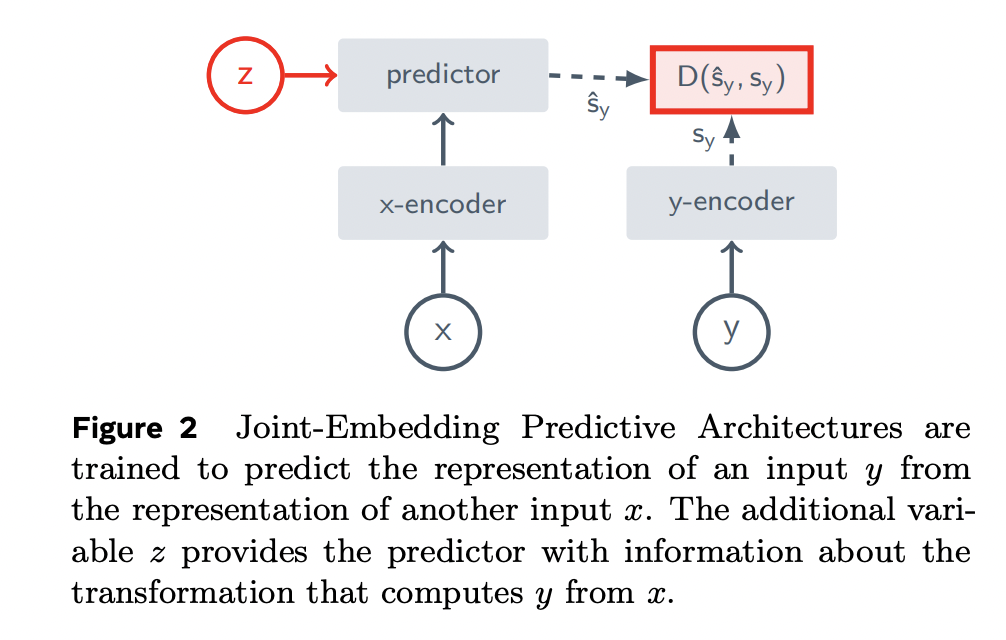
Main idea behind a JEPA is to learn to predict the representation of an input
Basic architecture is made of an encoder,
Which computes the representations of the inputs
and a predictor,
the variable
Training Objective
Visual Encoder
The predictor network
Network Parameterization
To process a video with transformer network, the video clip is split into 3D grid of L spatio-temporal patches (“tokens”)
The sequence of tokens is processed by stack of transformer blocks, inputs x and y correspond to masked regions of a video
A mask is applied by dropping a subset of tokens, take the input of the